


WaterVO TDS Meter
WaterVO TDS Meter
Couldn't load pickup availability
- Ships within 1-2 weeks
- 30-day return policy
- Manufacturer's warranty
KEY FEATURES
WaterVO TDS Meter · Compare. Record. Understand.
A little meter. Better questions about your water.
Turn everyday curiosity into a repeatable water routine. Compare dissolved-solids estimates at home or on the go, keep a baseline, and put changes into context—with a pocket-sized tool and support from WaterVO in Newport Beach, California.
- Compare your sources: explore tap, bottled and treated water using one consistent routine.
- Track your RO baseline: compare incoming and treated samples over time; account for blending and remineralization.
- Take curiosity along: pocket-sized for home, work and travel.
- Get local support: WaterVO support in Newport Beach, California, with a 1-year warranty.
One useful measurement—not a safety verdict. This conductivity-based meter estimates dissolved ionic material; it does not identify contaminants or establish that water is safe to drink.
Features & product details
| Measurement | Conductivity-based estimate of total dissolved solids (TDS) |
|---|---|
| Displayed unit | Parts per million (ppm) |
| Format | Pocket-sized handheld meter |
| Intended use | Compare water sources and track readings under consistent conditions |
| Warranty | 1 year |
| Support | WaterVO, Newport Beach, California |
Measurement range, model-specific accuracy, dimensions, battery specifications and temperature-compensation specifications are not documented in this listing. Follow the instructions supplied with the meter; no unverified technical ratings are claimed here.
Meet WaterVO. A US-based water company, here to help you understand your water.
WaterVO brings a straightforward approach to water: useful tools, clear explanations, and support based in Newport Beach, California. Our TDS Meter gives you a practical starting point for comparing water sources and tracking changes—without turning one number into a promise it cannot make.
A 1-year warranty and local support. Explore the WaterVO range at watervo.com.
Backed by Hydrology University
Educational guidance from Hydrology University's water-science resources helps put your reading in context. HU explains water technology using published sources and plain-language guidance, so you can understand what a TDS estimate means, what it leaves out, and which questions to ask next.
This educational backing is not laboratory certification, an independent test of this meter, or a guarantee of water quality or product performance.
WaterVO TDS Meter · Curiosity belongs in your pocket.
Your water has a number. WaterVO helps you give it context.
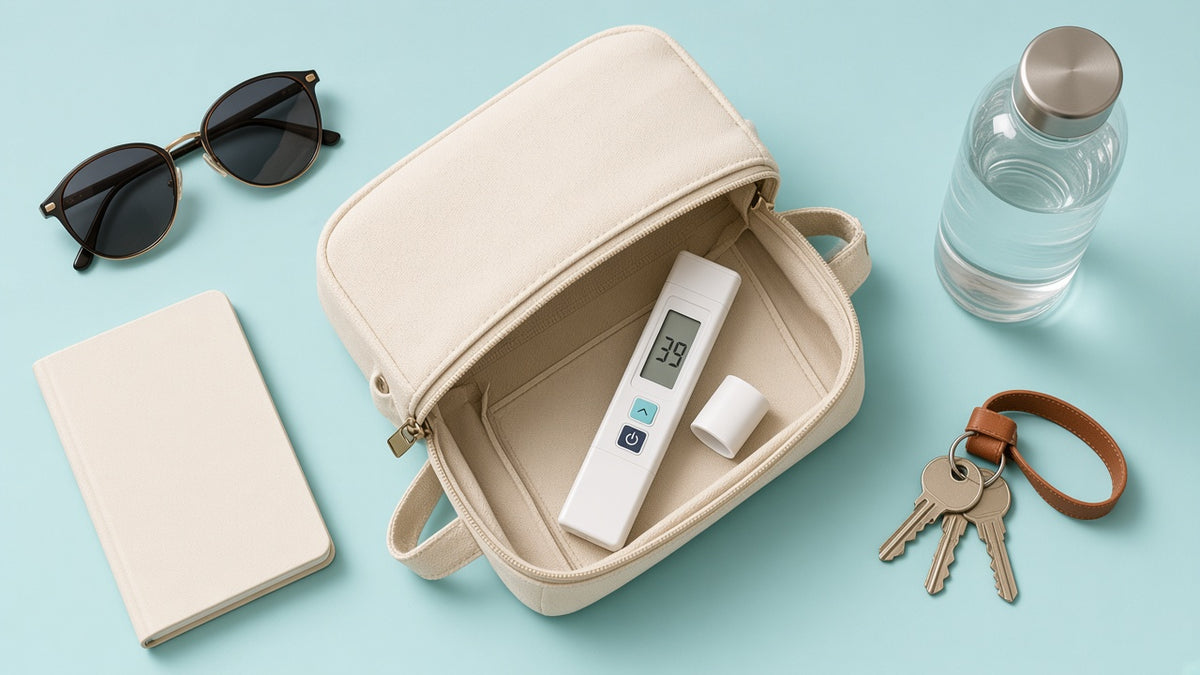
From the restaurant table to your hotel room, a pocket TDS meter makes dissolved-solids readings part of your everyday water routine. Compare sources, spot changes, and ask informed questions. We think it's an amazing, essential tell-tale tool for every curious water drinker to carry in a purse or pocket.
Your first line of defense against guessing—not against waterborne hazards. This meter is a first check for changes in dissolved ionic material, not a substitute for laboratory testing, treatment, or public-health advice.
$19.99 WaterVO Black Friday special · Normally $39.99 · Save $20 until Black Friday, November 27, 2026.
Local company. Local support in Newport Beach, California. 1-year warranty.
Add to Cart — $19.99 Understand your reading
Scene imagery illustrates possible uses; The displayed 39 ppm is illustrative, not a tested result for WaterVO water or this product.
Tap water. Filtered water. The bottle on your desk. Compare their dissolved-solids readings with the WaterVO TDS Meter—and learn what the differences can actually tell you.
Build a baseline, explore your water sources, and ask better questions about your filter. One useful measurement, not a verdict on your water.
Start with curiosity—not a safety score. A lower reading is not automatically better, and a higher reading is not automatically a problem.

What your number means
TDS means total dissolved solids: dissolved salts and other dissolved matter in water. A handheld conductivity-based meter estimates TDS primarily from how well dissolved ions carry electricity. Calcium, magnesium, sodium and other ions can affect the reading; it does not directly weigh every dissolved substance.
The display reports parts per million (ppm). In dilute water, 1 ppm is approximately 1 milligram per liter (mg/L). Conversion factors, temperature, calibration and water composition affect a conductivity-based estimate. No model-specific accuracy or automatic temperature-compensation claim is made here.
The WaterVO approach: know what TDS can—and can't—tell you
Use it to compare: conductivity-based estimates across water sources, changes over time, and the difference before and after an ion-reducing treatment such as reverse osmosis.
A TDS reading is not a water-safety test. This conductivity-based meter does not identify or quantify individual contaminants, distinguish forms of lead, or reliably detect bacteria, viruses, PFAS, microplastics, pesticides, chlorine, or chloramine. Low TDS does not prove water is safe, and higher TDS does not automatically mean it is unsafe. Use contaminant-specific testing when safety is the question.
USGS: how ions affect conductivity · WHO: TDS background document (PDF)
What readings might you see?
Tap-water TDS varies with source and treatment. EPA's secondary guideline for total dissolved solids is 500 mg/L, approximately 500 ppm in dilute water; it addresses aesthetic concerns and is not a water-safety threshold. RO can produce readings below 50 ppm, but results depend on the incoming water, system performance, and any blending or remineralization. A TDS number alone cannot identify the treatment used or establish safety.
| Water source | How to interpret the number |
|---|---|
| Tap | No universal typical band: source geology and treatment vary. Compare your utility's published results and your own consistent baseline. EPA's 500 mg/L secondary guideline is aesthetic, not a safety cutoff. |
| Filtered, including carbon | No universal filtered-water range. Many carbon filters leave dissolved mineral readings close to the incoming tap water even while reducing specific substances. |
| Reverse osmosis (RO) | Can be below 50 ppm before blending or remineralization. FDA illustrates 300 ppm feed becoming 15–30 ppm at 90–95% rejection; this is a conditional example, not a promise for any system. |
| Bottled | No single typical range covers purified, spring and mineral waters. Source, treatment and added minerals matter. Read the brand's water analysis; the label or price does not establish TDS or safety. |
WHO says water below about 600 mg/L is generally considered palatable and that palatability increasingly declines above about 1,000 mg/L. WHO has not proposed a health-based guideline for TDS. These are taste observations, not safe/unsafe bands.
EPA: secondary drinking-water standards · Read the 500 mg/L standard in 40 CFR 143.3 · WHO: taste and appearance guidance (PDF) · FDA: RO technical guide and conditional example
Look for context, not a color-coded verdict. Compare the source, treatment, and conditions behind a reading before drawing conclusions.
Have an RO system? Compare water in and water out.
Take separate samples of the water feeding your reverse-osmosis system and the treated water, following the system maker's sampling instructions. Record both readings under comparable conditions and repeat consistently over time.
RO generally reduces dissolved ions. A change from your usual before-and-after pattern is a reason to investigate—not a diagnosis of a failed membrane. Blending and remineralization can affect the result.
Not every filter is designed to lower TDS. Many carbon filters leave TDS largely unchanged while reducing specific substances. Follow your filter maker's maintenance and replacement instructions; do not use TDS alone to decide whether a filter works or needs replacing.
Where will you take your next reading?

Curious about restaurant “filtered water”?
Curious about a restaurant's filtered water? Ask which treatment system it uses. A TDS reading may be consistent with ion-reducing treatment such as reverse osmosis or deionization, but it cannot prove which process was used. Carbon filtration may leave TDS largely unchanged while reducing specific substances. A reading alone cannot prove water was unfiltered or that a restaurant misrepresented it.

At airports
Carry your meter in your day bag and compare a refill-station sample with your usual home baseline. A different reading is a reason to ask questions—not evidence of contamination. Follow posted drinking-water guidance.

In hotels and while traveling
Make a simple note of readings across your trip. Use only sources identified as potable, follow local travel-health advice, and never use a low TDS number to overrule a boil-water advisory or a warning not to drink the water.

At the office
See how the dispenser compares with the kitchen tap. Ask facilities which system is installed and when it was serviced. Maintenance records and treatment-specific evidence tell you things the meter cannot.
At home
Build a baseline across tap, your filter and bottled water. For RO, changes can prompt a maintenance check. For carbon filters, follow the maker's replacement schedule even if TDS barely changes.
Don't just trust “filtered”—ask what it means.
“Filtered” describes a process, not one universal result. As a price analogy, red wine might be $3 a bottle or $1,000; the word “wine” does not tell you the whole story. Water equipment also spans simple inexpensive filters, multi-stage systems and a vapor-source machine such as WaterVO. A hypothetical $1 filter and a VO machine are not equivalent treatments.
Price alone does not establish performance, and WaterVO starts with water vapor rather than simply filtering the restaurant's tap water. Ask about the source, the exact model, what it is documented to do, and maintenance. Your meter adds one useful piece of information; it cannot identify the system or certify the water.
CDC: choose a filter for the substances you need to address · Explore Hydrology University's Testing Hub
Peace of mind starts with understanding.
The confidence to ask better questions. A repeatable reading to compare. A local team to turn to. That's the kind of peace of mind we want this little tool to bring—not false reassurance about contaminants it cannot measure.
An ideal stocking stuffer
A practical conversation starter for the traveler, curious friend or water nerd in your life. Give them a new way to explore the water they use every day.
Add to Cart — $19.99 Understand your reading
How to use your WaterVO TDS Meter: three simple steps
- Prepare your sample. Use a clean container and follow the instructions supplied with your meter. For comparisons, use samples at similar temperatures.
- Take the reading. Follow the supplied directions for immersing the probe and wait for the reading to stabilize. Avoid touching the probe surfaces.
- Record, rinse, repeat. Note the source, date, and reading. Rinse the probe between samples and maintain or calibrate it as directed. Compare against your own baseline under consistent conditions.
WaterVO answers your TDS questions
Does a low reading mean my water is safe?
No. A TDS number does not establish safety. Use contaminant-specific testing for the substances you need to assess.
Is 500 ppm a pass-or-fail line?
No. EPA's secondary guideline addresses aesthetic concerns, not a water-safety threshold. A reading alone cannot tell you whether water is safe or unsafe.
Why didn't my carbon filter lower the number?
Carbon filtration and dissolved-ion reduction are different functions. An unchanged reading alone does not show that a carbon filter is ineffective.
Can I use this to track my RO system?
Yes—as one comparison tool. Track incoming and treated water under consistent conditions, account for blending or remineralization, and follow the system maker's maintenance guidance.
Can the meter tell me exactly what's in my water?
No. It estimates dissolved ionic material from conductivity; it does not identify individual substances or replace a targeted water test.
Make curiosity part of your water routine.
Use the WaterVO TDS Meter to compare, record, and learn. Exploring a different water source? Discover WaterVO Vapor Optimizers and Spout at watervo.com, and choose a unit based on its documented features—not a TDS number alone.
WaterVO Vapor Optimizers begin with water vapor in the air around you. They condense that vapor, pass collected water through the unit's optimization stages, and make it available at home without a plumbing or drain connection. Depending on the model, hot and cold dispensing adds everyday convenience.
Why we love this approach: fewer jugs to carry and a water source you can explore in your own space. Output depends on temperature and humidity. WaterVO atmospheric water generators are not certified or registered to remove or reduce contaminants; a TDS number does not establish health benefits or contaminant removal.
Explore WaterVO Learn with Hydrology University More accessories
Explore WaterVO units and Spout · Understand your water at hydrologyuniversity.com


The Future of Drinking Water Is Here
Water solutions for your home, from filtration systems to WaterVO Vapor Optimizers that make water from the air.